
Assess evidence, not vocabulary
The experience should look for relevant responsibilities, outcomes and transferable patterns rather than rewarding surface-level keyword overlap.
AI-Enabled Decision Support
Turning role-fit ambiguity into a clearer, evidence-led conversation.
A live AI-enabled role-fit assessment designed to help hiring teams examine alignment, relevant evidence, potential gaps and areas worth exploring in conversation — without pretending the system should make the hiring decision.

Overview
The harder problem was helping a hiring team examine fit with enough structure to be useful, enough evidence to be credible and enough humility to keep the final judgment human.
The Decision Problem
The product needed to create structure without creating false certainty.
Where The Judgment Showed Up
The experience should look for relevant responsibilities, outcomes and transferable patterns rather than rewarding surface-level keyword overlap.
A credible assessment should help the user understand both the strongest alignment and the areas that require validation or deeper conversation.
The result should provide useful areas to explore, not simply a score or generic summary.
The product supports interpretation. It does not possess the organizational context, accountability or human understanding required to make the hiring decision.
Experience Design
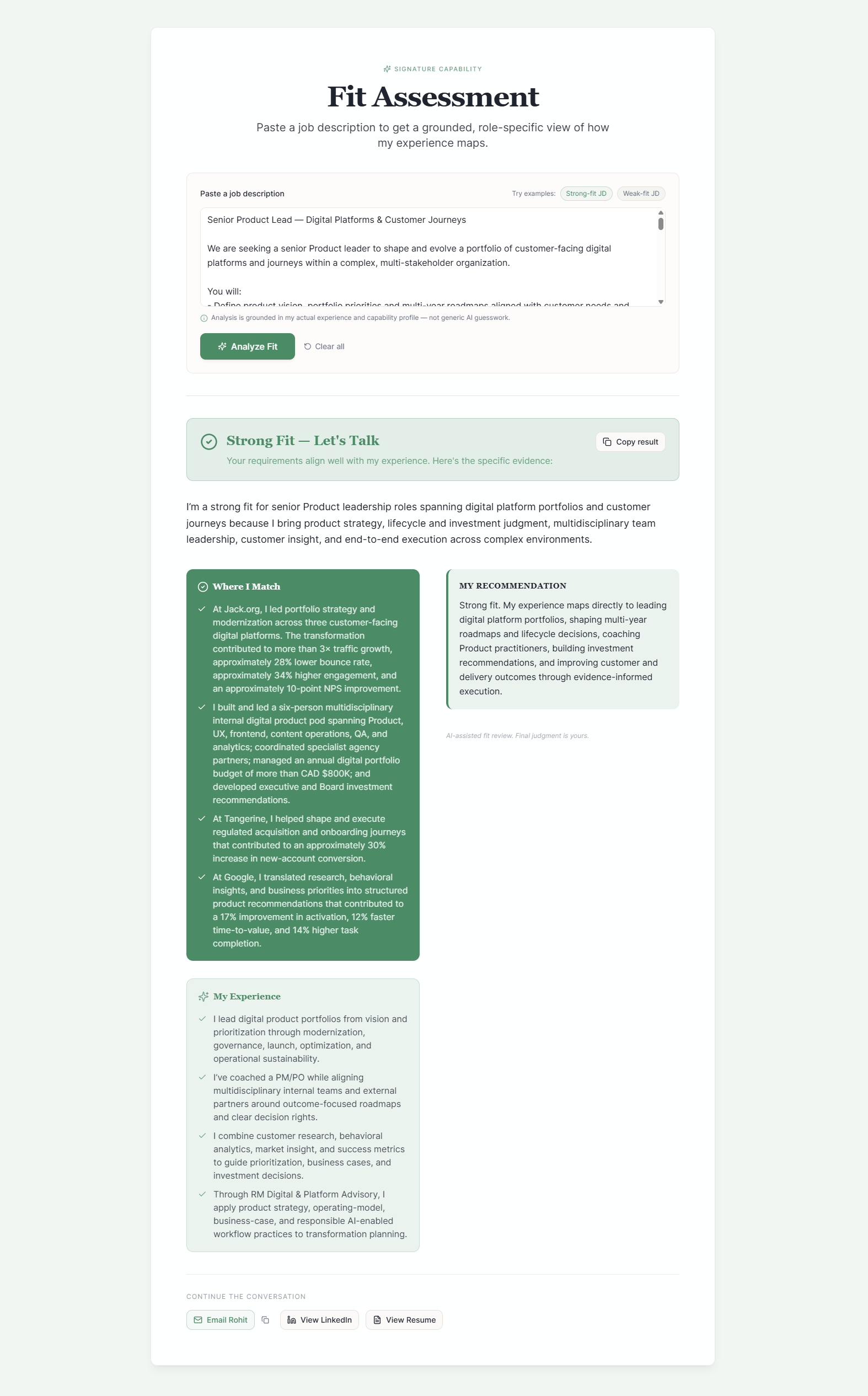
The user supplies the job description or role context they want to examine.
The product organizes the role into meaningful expectations rather than treating it as an undifferentiated block of text.
The experience examines where Rohit’s background and outcomes provide credible alignment and where evidence is weaker or incomplete.
The result surfaces strengths, gaps and areas worth testing through recruiter or hiring-manager discussion.
Technical Architecture
React and TypeScript front end connected to Supabase Edge Functions and a structured candidate-evidence layer. Versioned evidence, retrieval and verdict guardrails separate AI interpretation from deterministic decision logic, while public-response controls keep private provenance and internal metadata out of the experience.
Human Boundaries
The user remains responsible for determining whether the candidate should progress.
The assessment is constrained by the role description and available candidate evidence.
Users should investigate unsupported certainty, missing evidence and role-specific assumptions.
The most valuable next step is often a better recruiter or hiring-manager discussion.
An AI-assisted assessment can improve preparation. It cannot understand every organizational reality surrounding the role.
Validation Approach
Evaluation and validation
The assessment was reviewed against eight frozen job-description fixtures spanning aligned, adjacent and hard-negative roles. Reference outcomes covered all three verdict levels: Strong Fit, Worth a Conversation and Probably Not Your Person.
Automated regression checks verified benchmark behaviour and repeatability, while expert review identified where explanations were too generic, evidence attribution needed strengthening or confidence exceeded the available evidence.
What I Learned
The quality of the input shapes the credibility of the assessment.
A balanced result is more useful than an enthusiastic result.
Users need reasons and discussion prompts, not only conclusions.
Product trust depends as much on boundaries and language as on the underlying system.
What Evolves Next
Develop a more explicit review approach for evidence quality, unsupported claims, gaps and usefulness.
Improve how role expectations, supporting evidence and discussion areas are presented.
Continue clarifying what the product can support, where uncertainty remains and when human review must override the output.
Why This Product Matters
Rohit’s AI Navigator demonstrates how AI can support a practical, ambiguous decision while keeping evidence, uncertainty and human accountability visible.