
Tangerine Bank · Investment Funds · 2016–2019
Case study · Regulated investment growth
Tax season created the moment.
Recurring investment behaviour created the value.
As Senior Product Marketing Specialist, I led the commercial growth system around Tangerine Investment Funds—connecting product positioning, roadmap input, seasonal go-to-market strategy, lifecycle engagement, digital journeys, analytics, and cross-functional execution to help turn savings intent into funded, recurring investment relationships.
- Role
- Senior Product Marketing Specialist
- Primary mandate
- Tangerine Investment Funds
- Program window
- 2017–2018 Tax Season GTM
- What I led
- Commercial growth strategy · roadmap input · lifecycle engagement · digital journeys · analytics and measurement
- Collaboration
- Product · UX · CRM · Analytics · Technology · Legal and Compliance · creative and media partners
- Primary outcome
- Contributed to a 30% year-over-year increase in Pre-Authorized Contribution (PAC) activations
Why this is product-leadership evidence
This work required framing customer problems, influencing product and journey priorities, making regulated trade-offs, aligning multidisciplinary teams, and measuring downstream customer behaviour—not simply delivering a campaign.
- Roadmap and journey input
- Customer and funnel diagnosis
- Cross-functional prioritization
- Funded and recurring behaviour measurement
+30% YoY
PAC activations
2017–2018
Tax Season GTM
INVESTMENT FUNDS
Primary portfolio mandate
REGULATED GROWTH
Product, marketing, analytics, technology, and compliance
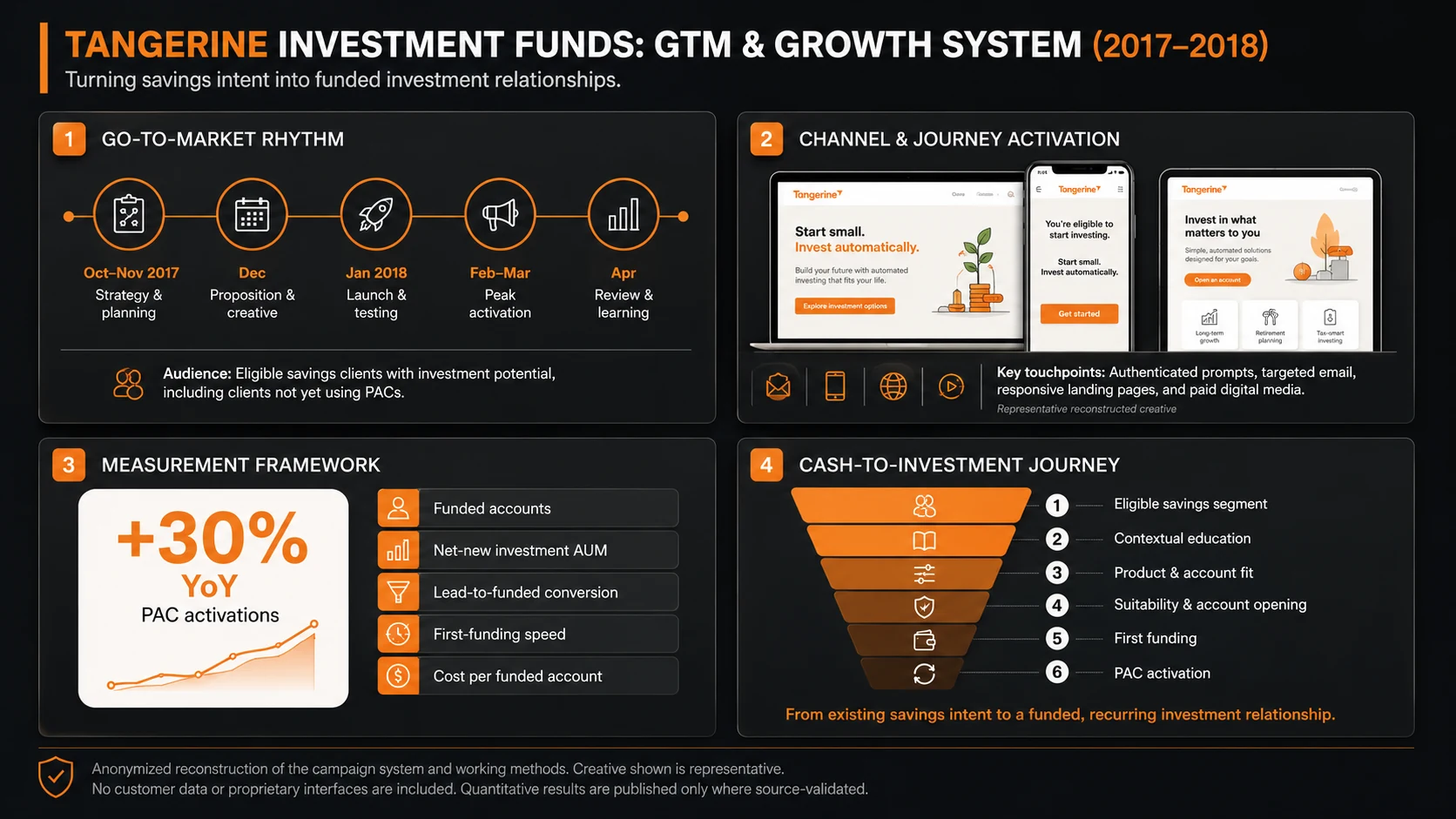
Anonymized reconstruction of the campaign system and working methods. Creative shown is representative. No customer data or proprietary interfaces are included. Quantitative results are published only where source-validated.
The real problem
The visible goal was Tax Season growth.
The consequential goal was a funded, recurring investment relationship.
Investment growth was not simply a matter of sending more customers to a product page. Existing savings clients had to recognize an investment need, understand product and account choices, complete a mandatory suitability process, open and fund an account, and build a contribution habit. Friction or uncertainty at any stage could turn strong intent into an inactive account.
The surface brief
Deliver a high-performing Tax Season program
Deliver a high-performing Tax Season program for Tangerine Investment Funds.
The system brief
Connect the whole regulated growth journey
Connect customer segmentation, product education, suitability, account opening, first funding, PAC activation, and measurement as one regulated growth system.
Observed journey patterns and working hypotheses
Friction 01
Suitability uncertainty
Customers had to interpret risk tolerance, investment horizon, and regulatory questions without the support of a traditional branch conversation.
Friction 02
Product and account complexity
Investment products, customer goals, registered-account structures, fees, risk, and tax considerations could create decision overload.
Friction 03
Opened but not activated
Account opening did not automatically create value. The relationship became meaningful only after first funding and the establishment of sustainable contribution behaviour.
Three product decisions
Where the judgment showed up.
Three consequential product decisions shaped how the growth program treated customer behaviour, product choice, and regulated conversion.
01Optimize for recurring investment behaviour, not only seasonal deposits.
Optimize for recurring investment behaviour, not only seasonal deposits.
Why it mattered
Tax season created strong short-term intent, but one-time contributions did not necessarily create an enduring investment relationship. PAC adoption offered a stronger path to recurring customer behaviour.
Decision
Elevate Pre-Authorized Contribution activation as a primary commercial and customer-behaviour outcome within the Tax Season program.
Trade-off
Prioritizing recurring behaviour reduced emphasis on the largest immediate deposit in exchange for stronger long-term contribution consistency.
Leverage created
A more durable definition of growth—moving from a seasonal transaction toward an ongoing investment habit.
Principle
Optimize for customer behaviour that compounds.
02Organize investment choices around customer goals, not internal product taxonomy.
Organize investment choices around customer goals, not internal product taxonomy.
Why it mattered
Customers had to understand the relationship between goals, investment products, risk, registered-account structures, fees, and tax considerations. Technical completeness could easily create decision overload.
Decision
Lead with customer goals, plain-language value, and decision-relevant distinctions while preserving deeper product and regulatory detail at the appropriate level.
Trade-off
Not every technical attribute belonged in the primary acquisition message. Detailed information remained available through secondary content and disclosures.
Leverage created
Clearer positioning, reduced choice overload, and stronger alignment between the campaign promise and the product-selection journey.
Principle
Product architecture should reflect how customers decide—not only how the institution categorizes products.
03Treat regulatory clarity, first funding, and PAC setup as part of conversion.
Treat regulatory clarity, first funding, and PAC setup as part of conversion.
Why it mattered
Suitability, account opening, first funding, and PAC setup were sequential dependencies. Optimizing only the landing page could not solve downstream abandonment.
Decision
Coordinate product communication, plain-language guidance, authenticated prompts, first-funding expectations, and PAC activation as one journey.
Trade-off
Achieving clearer regulated communication required additional legal and compliance review, increasing coordination before launch.
Leverage created
A more coherent path from marketing engagement to a funded account and recurring contribution relationship.
Principle
In regulated products, compliance, communication, and conversion are one system.
Growth system
Four connected modules turned seasonal intent into recurring behaviour.
The four modules below interpret the reconstructed GTM artifact — the operating system, not a single campaign burst.
Go-to-market rhythm
The program operated as a learning cycle rather than a single launch event.
- Strategy and proposition development
- Launch testing and peak activation
- Post-campaign review and learning
Value created
Created a repeatable rhythm for managing a regulated seasonal-growth program.
Channel and journey activation
Paid and owned channels carried one consistent customer promise into an increasingly specific investment journey.
- Authenticated prompts and CRM nurture
- Responsive product education
- Paid digital acquisition
“Start small. Invest automatically.”
Value created
Reduced the gap between campaign interest and the next meaningful customer action.
Measurement framework
The measurement model connected marketing activity to funded and recurring behaviour.
Primary validated result
+30% YoY PAC activations
Supporting measures
- Qualified engagement
- Funded investment accounts
- Net-new investment AUM
- Lead-to-funded conversion
- First-funding speed
- Cost per funded account
Value created
Shifted attention beyond impressions, clicks, and applications toward durable customer behaviour.
Cash-to-investment journey
Customer progression depended on six connected stages—not a single page or message.
- 1Eligible savings segment
- 2Contextual education
- 3Product and account fit
- 4Suitability and account opening
- 5First funding
- 6PAC activation
Value created
Connected savings intent to a funded, recurring investment relationship.
Evidence & impact
Seasonal demand became recurring investment behaviour.
The 2017–2018 Tax Season investment-growth program connected customer segmentation, product education, channel activation, regulated account opening, first funding, and PAC adoption. The program contributed to a 30% year-over-year increase in Pre-Authorized Contribution activations.
The outcome reflected coordinated product positioning, lifecycle engagement, digital journey, regulatory review, channel execution, and measurement—not a single message or interface change.
+30% YoY
PAC activations — Contributed to a 30% year-over-year increase in Pre-Authorized Contribution activations through the Tax Season investment-growth program.
Customer value
- Clearer investment propositions
- More understandable goal, product, and account choices
- Greater confidence about suitability and next steps
- A lower-intimidation path to begin through recurring contributions
Business value
- 30% year-over-year increase in PAC activations
- Stronger recurring contribution behaviour
- More meaningful progression from savings relationship to funded investment relationship
- A measurement model connected to funded behaviour
Organizational value
- Stronger alignment across Product, Marketing, Analytics, CRM, Technology, Legal, and Compliance
- Better connection between customer behaviour and GTM decisions
- A reusable rhythm for regulated seasonal growth
- Stronger measurement beyond top-of-funnel activity
Public experience context
The public experience kept evolving around one enduring challenge: making investment choices understandable.
Earlier public investment experience
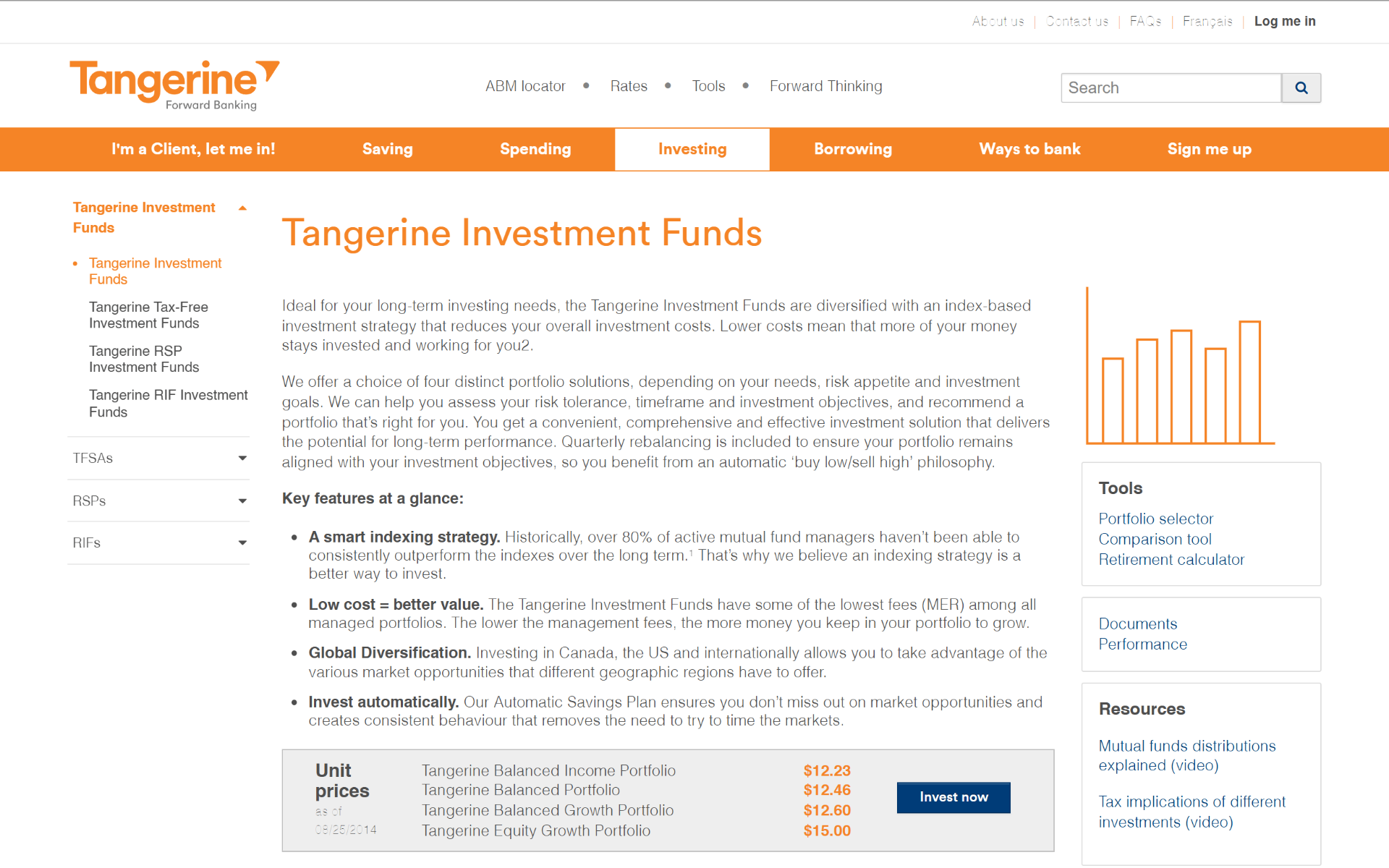
- Product- and taxonomy-led navigation
- Dense investment explanation
- Products and account structures competing for attention
- Significant customer effort required to interpret available choices
Contemporary public investment experience

- Modular product and account choices
- Clearer decision pathways
- Supporting tools and educational resources
- Regulatory disclosures retained within the experience
Adjacent regulated-product breadth
Alongside the Investment Funds mandate, I supported customer and growth initiatives across savings, deposits, Personal Line of Credit, Line of Credit, and Home Equity Line of Credit.
- Savings and deposits
- PLOC and LOC
- HELOC
These adjacent mandates broadened my understanding of liquidity, borrowing, eligibility, affordability, repayment, and responsible financial decision-making.
Value created
What this proves for the next team.
Product and commercial judgment
I connect product positioning, customer journeys, go-to-market execution, and business measurement.
Regulated growth
I simplify complex choices without weakening customer confidence or regulatory integrity.
Cross-functional leadership
I align Product, Marketing, Analytics, Technology, Legal, Compliance, and external partners around one outcome.
Durable value creation
I optimize for funded and recurring customer behaviour—not only short-term campaign response.
What I would strengthen with today's capabilities
With today's instrumentation and experimentation capabilities, I would add more granular stage-level event tracking, cohort-based funnel analysis, structured abandonment feedback, stronger CRM-to-funded-account attribution, and clearer experimental governance. That would make it faster to distinguish problems of intent, product fit, comprehension, suitability, usability, first funding, and recurring-contribution activation.
Next step