JACK.ORG · BE THERE CERTIFICATE · 2022–2025
CASE STUDY · PLATFORM RESILIENCE & LEARNING-PRODUCT GROWTH
The program had found its audience.
The platform could not carry the demand.
When I joined Jack.org, Be There Certificate was a newly launched and highly differentiated mental-health learning product. Its content and mission were strong, but the plugin-heavy WordPress infrastructure supporting accounts, course progress, renewals, system communication, and certificate completion was unstable. I initially focused on stabilizing the existing system. As demand accelerated, it became clear that continued patching would put learner trust and future growth at risk.
- Challenge
- Stabilize and scale a high-demand learning product constrained by an unreliable WordPress and plugin architecture.
- Role
- Senior Manager, Digital Products & User Experience
- Project window
- Agreement signed April 17, 2023 · Full launch August 21, 2023
- Scope
- Platform strategy, RFP, architecture, vendor leadership, data migration, QA/UAT, cutover, and post-launch operations
- Collaboration
- Internal developer, Be There Certificate product manager, UX/UI and graphics support, Finsweet technical and senior leadership, program executives, and Webflow Enterprise
- Outcome
- A resilient multilingual learning platform supporting sustained growth and reliable learner access
Evidence note: This case reconstructs the product, migration, and operating decisions using retained project records, internal performance documentation, implementation-partner reporting, and public program information. Internal system details and user data have been anonymized.
PORTFOLIO CONTEXT
Protecting a growing product while the portfolio continued to evolve.
Be There had established demand and an expanding learner base, but its platform needed greater resilience and operational clarity. The portfolio decision was not to interrupt growth with unnecessary reinvention, but to strengthen the infrastructure supporting it.
MY PORTFOLIO ROLE
Modernize the foundation without destabilizing the product.
01
PLATFORM STRATEGY
Directed the platform and migration approach around resilience, maintainability and continuity for a multilingual public-learning product.
02
DELIVERY GOVERNANCE
Coordinated internal product ownership with specialist agency capacity, launch readiness and post-launch operational responsibility.
03
GROWTH CONTEXT
Supported continued product adoption while preserving stable access across English, French and Spanish experiences.
PROBLEM FRAMING
The visible problem was platform instability.
The consequential risk was losing learner trust at the moment demand was accelerating.
The original WordPress learning environment depended on more than twenty plugins supporting accounts, course progress, renewals, system emails, content management, and certificate completion. These components did not operate as one dependable product system.
During periods of increased attention, learners encountered login problems, blocked account creation, broken progress states, and long pages that could prevent them from continuing the course. Internal teams also struggled to make timely content updates while responding to recurring support issues.
The important signal was easy to miss: the instability was occurring because people wanted the program. The product had found demand, but the infrastructure could not carry it.
- Crashes and degraded performance
- Login and account-creation friction
- Course-progress and renewal issues
- Operational firefighting
- Slow content updates
- Learners losing confidence
- Interest fading after high-profile attention
- Program growth constrained by infrastructure
- Increased support and maintenance burden
- Institutional partners questioning reliability
Demand was growing.
The existing system could not reliably absorb relatively modest concurrent-user surges.
Continued patching risked damaging a differentiated program with strong product potential.
THREE DECISIONS
Where the product judgment showed up.
Stabilize before replacing.
- Evidence
- The system was recently launched and represented significant organizational investment. Blue State was winding down its involvement, while technical support was expected to transition to another vendor.
- Tension
- Immediately replacing the platform could introduce migration risk before the architecture and failure modes were fully understood. Continuing indefinitely with reactive maintenance would preserve the same fragility.
- Decision
- I spent the initial months diagnosing the existing system, supporting learners, documenting recurring issues, and understanding the account, progress, content, and certificate workflows before recommending a new platform direction.
- Trade-off
- Accept short-term operational burden in exchange for a better-informed transformation decision.
- Principle
- Diagnose the system before prescribing the platform.
MIGRATION SYSTEM
A six-month transformation protected the live learner journey while replacing its foundation.
I oversaw the complete client-side delivery system: discovery, RFP, architecture approval, backlog management, QA, UAT, data validation, security review, cutover planning, rollback preparation, launch communications, and post-launch support. During the major phase of the project, I reported directly to the CEO while working closely with Be There Certificate program executives and the Finsweet leadership and technical teams.
Reconstructed product artifact
Platform Resilience & Learner Continuity Blueprint
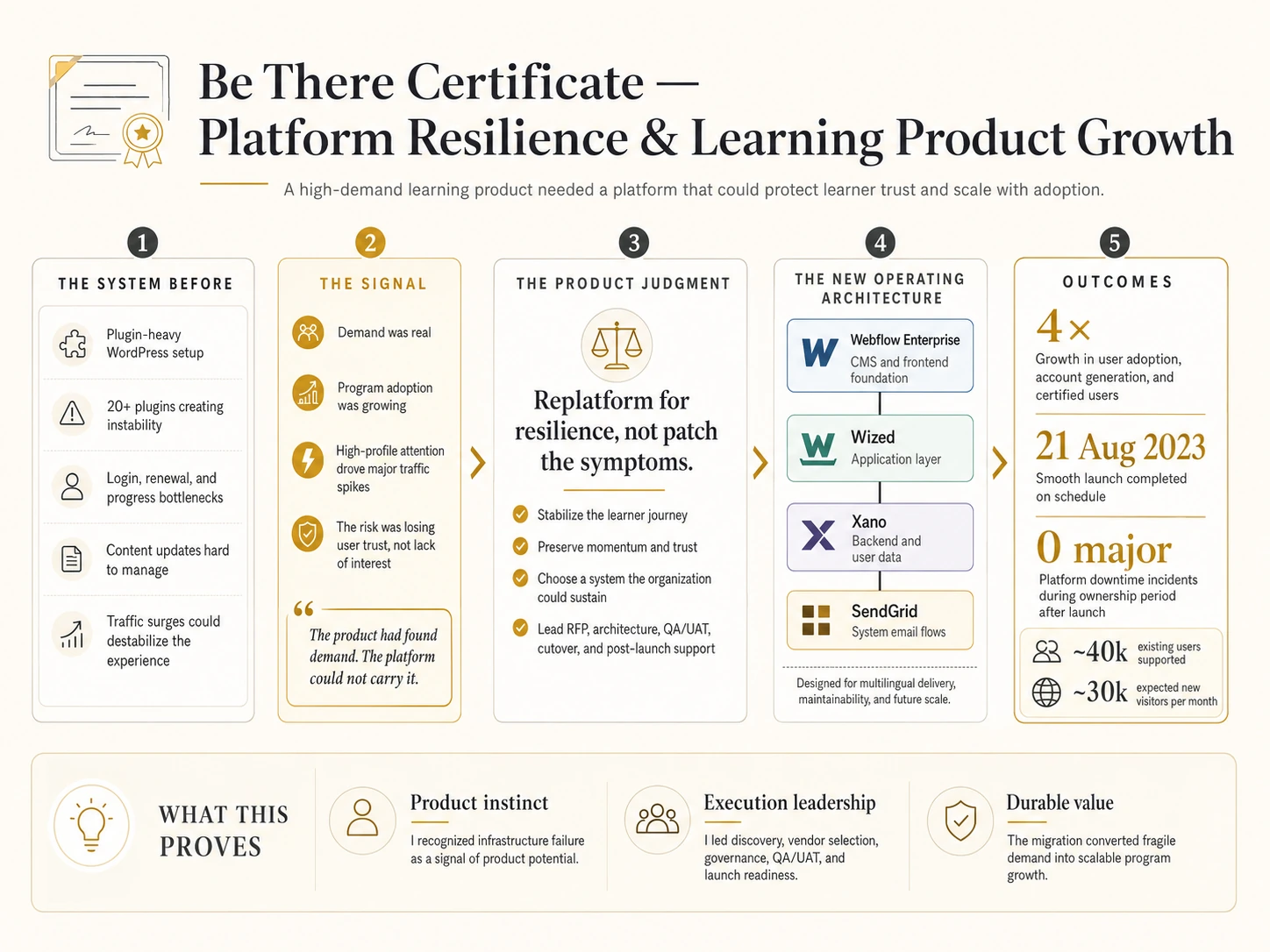
This reconstructed blueprint summarizes the progression from plugin-driven instability to a modular learning-product architecture and the post-launch outcomes that followed. It contains no proprietary user information or internal system data.
Platform and partner selection
- Worked with the Webflow Enterprise account team
- Evaluated agencies against LMS experience, enterprise Webflow expertise, nonprofit alignment, database capability, design quality, agility, and collaboration
- Selected Finsweet as implementation partner
- Approved the final architecture after technical due diligence
Learner and data continuity
- Preserve accounts and course-progress states
- Protect certificate-generation workflows
- Validate multilingual experiences
- Migrate learner and program data
- Maintain system-email and reminder journeys
Delivery and launch governance
- Product backlog and dependency management
- Iterative QA and UAT
- Data and security validation
- Cutover and rollback planning
- Executive and program-team alignment
- Early-morning multilingual launch window
Post-launch operations
- Rapid issue triage
- Minor user issues resolved within defined response windows
- Larger investigations managed to closure
- Ongoing product expansion
- Refresher-program groundwork initiated during 2025
EVIDENCE & IMPACT
The launch converted fragile demand into reliable learning-product growth.
The migration contributed to fourfold growth across user adoption, account generation, and certified users during the six months following launch.
Zero major downtime incidents occurred during the post-launch period I personally oversaw, from August 2023 through September 2025. Random learner-specific issues were triaged and resolved through the new support model without becoming platform-level incidents.
The new English, French, and Spanish experiences launched on August 21, 2023 within the planned early-morning cutover window, without a major launch incident.
Implementation-partner reporting documented the migration of more than 60,000 users and approximately 1.2 million records.
Project planning anticipated supporting approximately 40,000 existing users and around 30,000 new visitors per month.
- 4× growth: retained internal performance documentation
- Launch and reliability period: project records and direct operating oversight
- Migration scale: implementation-partner reporting
- User and traffic assumptions: project planning documentation
The program continued expanding after my tenure. Subsequent public milestones are included only as evidence of the platform and program’s longer-term trajectory, not as results attributed solely to my work.
PUBLIC PRODUCT EXPERIENCE
The infrastructure changed. The learner experience remained the product.
The current Be There Certificate website preview shows the learner-facing product made possible by the platform transformation: a multilingual learning journey designed to help people recognize when someone may be struggling, reach out safely, and connect them with appropriate support.
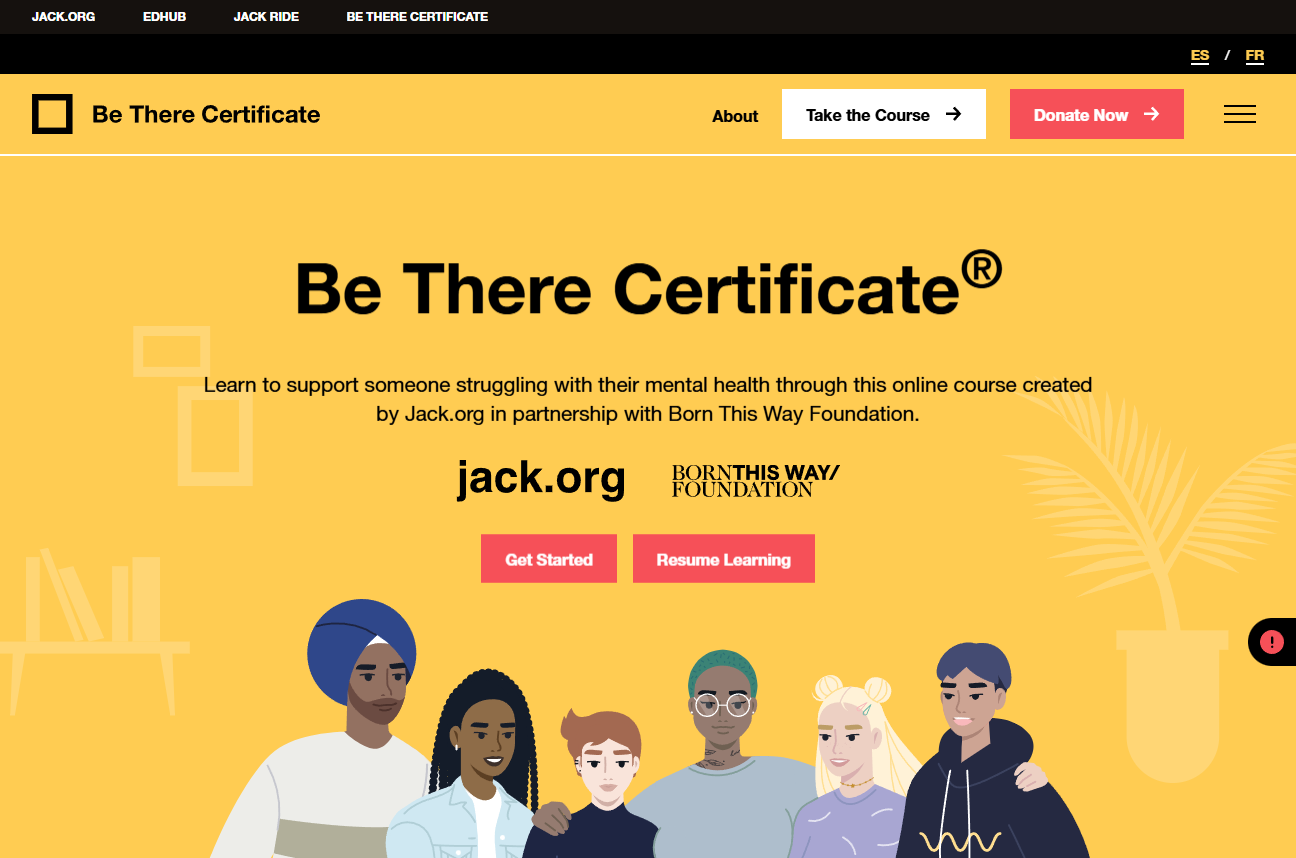
This top-of-page public website screenshot reflects the product as it exists today. The experience continued to evolve after the 2023 migration and after my tenure, so it is included as product context rather than evidence that every visible feature or later enhancement was delivered by me.
VALUE CREATED
What this work left behind.
A differentiated mental-health learning experience no longer depended on a fragile plugin chain.
Users could create accounts, return to the course, complete modules, and receive certificates through a more reliable journey.
The organization gained a maintainable architecture, clearer ownership, a support model, and a stronger foundation for future features.
The platform could support broader institutional, corporate, and international adoption without recreating the previous operational burden.
- I identify product potential beneath technical and operational noise.
- I balance continuity risk against the need for structural change.
- I lead platform, partner, data, and launch decisions as one product system.
- I build operating models that sustain value after migration is complete.
REFLECTION
What I would strengthen next.
What I would strengthen with today’s capabilities
With today’s tooling, I would establish more formal pre-migration observability and reliability baselines earlier—including concurrent-user thresholds, account-creation failure rates, progress-state errors, certificate-generation completion, support-ticket volume, and recovery times. This would make the reliability improvement easier to quantify alongside the strong adoption and completion outcomes.
PART OF THE JACK.ORG DIGITAL PORTFOLIO
The resilience work demonstrated how the portfolio could preserve a growing product while strengthening its underlying platform.
Next step