
Jack.org · Digital Products & User Experience · 2022–2025
Case Study · Digital Ecosystem Modernization
The project was a website rebuild.
The real work was redesigning the system behind it.
I led Jack.org's migration from Kentico to Webflow Enterprise and strengthened the governance, analytics, and delivery practices that made its digital ecosystem easier to operate, learn from, and scale.
- Challenge
- Modernize a fragmented digital foundation serving multiple audiences and programs.
- Role
- Senior Manager, Digital Products & User Experience
- Scope
- Platform strategy, CMS migration, stakeholder alignment, agency delivery, analytics, QA, UAT and launch readiness
- Launch
- November 1, 2024
- Leadership scope
- CAD $800K+ annual digital operating budget responsibility
- Outcome
- A more scalable, measurable, and better-governed digital ecosystem
3×+
Overall site traffic growth
−28%
Bounce-rate reduction
+34%
Engagement growth
On time
Launched November 1, 2024
Portfolio context
The flagship transformation within a wider digital ecosystem.
Jack.org was the central platform in an interconnected portfolio that also included edHUB, Be There Certificate and shared analytics, governance, vendor and operating relationships. The challenge was therefore larger than replacing a CMS: it required deciding how the portfolio should evolve, where to invest and how to sustain the change after launch.
My portfolio role
Modernize the platform while strengthening the system around it.
01
Portfolio direction
Translated organizational priorities into platform sequencing, modernization investment, delivery governance and measurable customer outcomes across the wider digital portfolio.
02
Operating model
Led a six-person internal product pod, including a dedicated Product Manager/Product Owner, and governed a flexible 3–4 person specialist agency overlay.
03
Executive context
During an extended VP leadership vacancy, reported directly to the CEO and Interim CEO and worked with executive leadership and the Board on priorities, investment decisions, progress, trade-offs and risk.
Problem framing
The visible problem was a website.
The consequential problem was the system.
Jack.org had to serve two very different forms of intent: young people and educators seeking mental health programs and resources, and donors and corporate partners seeking credible ways to support the mission. The organization needed more than a visual refresh — it needed a digital foundation it could sustain and learn from.
The surface brief
Modernize Jack.org's public website
Refresh the experience, reflect the evolving brand and communicate the organization's work more clearly.
The system brief
Create a platform the organization could sustain
Reduce operational friction, clarify audience journeys, improve measurement and build governance into delivery.
Signal 01
Multiple audience needs
Youth, educators, donors, partners and internal teams needed different pathways and outcomes.
Signal 02
Legacy platform constraints
The previous CMS restricted speed, maintainability and future iteration.
Signal 03
Weak learning loops
Analytics, behavioural visibility and post-launch learning were not part of the operating model.
Three decisions
Where the judgment showed up.
Three consequential decisions shaped the ecosystem modernization — from reframing the brief, to platform choice, to building the operating layer alongside the public experience.
01Reframe the brief from redesign to ecosystem modernization.
Reframe the brief from redesign to ecosystem modernization.
Evidence
The public website was the visible output, but the underlying constraints involved technology, content operations, governance, analytics, multiple audience needs and partner dependencies.
Tension
A conventional redesign could improve perception while preserving the same operational and platform problems.
Decision
Expand the framing to include platform direction, audience journeys, internal content workflows, governance, measurement, QA and UAT, and post-launch iteration.
Trade-off
This required more alignment, scope discipline and organizational coordination before and during delivery.
Leverage created
The launch improved the future operating model, not only the launch-day interface.
Principle
Solve the system behind the visible problem.
02Choose a platform for organizational fit, not maximum technical complexity.
Choose a platform for organizational fit, not maximum technical complexity.
Evidence
The organization needed greater flexibility and speed, but also required a platform that internal teams and external partners could realistically sustain.
Tension
A highly custom stack could offer greater theoretical flexibility while increasing technical dependency, cost, maintenance complexity and delivery risk.
Decision
Migrate from Kentico to Webflow Enterprise.
Trade-off
Webflow Enterprise would not provide unlimited custom engineering flexibility, but it offered a stronger balance of autonomy, governance, maintainability and speed for the organization's context.
Decision criteria
- Internal maintainability
- Design flexibility
- Agency and vendor support
- Content governance
- Cost and implementation risk
- Speed of iteration
- Analytics readiness
- Long-term organizational fit
Leverage created
Internal teams could operate and evolve the digital experience with less dependency and a more manageable platform model.
Principle
Optimize for sustainable organizational capability, not theoretical technical flexibility.
03Build the operating layer alongside the public experience.
Build the operating layer alongside the public experience.
Evidence
A new website without ownership, release discipline, analytics or a learning loop could eventually reproduce the previous problems.
Tension
Delivery pressure naturally focuses attention on launch. Governance and measurement can be deferred when treated as secondary work.
Decision
Strengthen the operating system through Website Task Force collaboration, structured stakeholder reviews, QA, UAT, launch-readiness practices, GA4, Google Tag Manager, Microsoft Clarity, funnel and behavioural visibility, and post-launch learning practices.
Trade-off
Adding operating discipline required additional coordination and attention during an already complex migration.
Leverage created
The organization gained stronger release confidence, better analytics visibility and a clearer foundation for future iteration.
Principle
A launch is valuable only when the organization can operate, measure and improve what comes next.
The operating model
A repeatable cycle, with product judgment at the centre.
- 01
Frame
- Intake
- Audience needs
- Constraints
- Success measures
- 02
Decide
- Prioritize
- Make trade-offs
- Align stakeholders
- Establish ownership
- 03
Deliver
- Design
- Build
- QA and UAT
- Launch
- 04
Learn
- Measure
- Interpret
- Improve
- Repeat
The system changed from request-to-launch delivery into a repeatable cycle of framing, decisions, execution and learning.
Visual evidence
The visible transformation was only one layer.
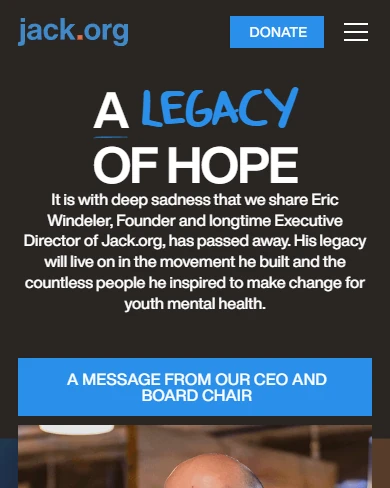
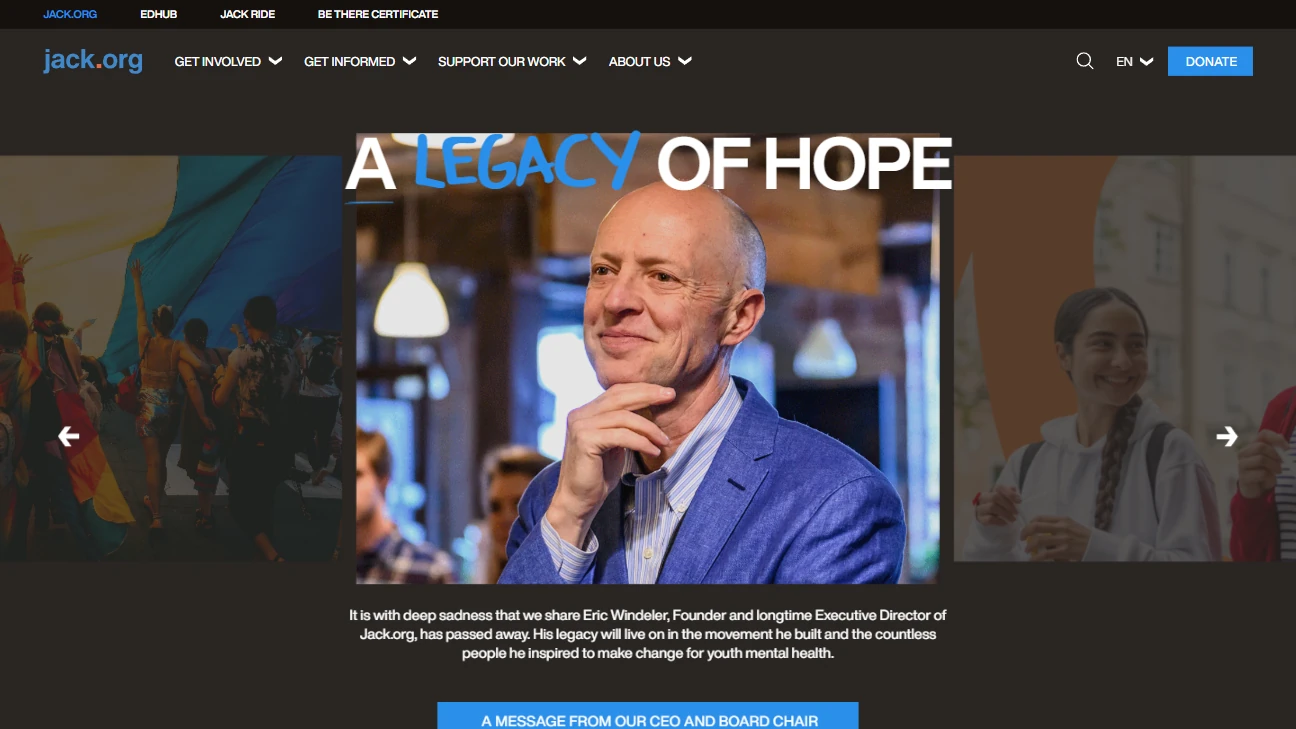
The new experience introduced clearer hierarchy, more modular storytelling and a stronger foundation for future content. Compare the top of both sites below, or open the full-page explorer to inspect either in complete detail.
The screenshots represent different live content moments. The comparison focuses on hierarchy, modularity, responsive behaviour, and platform capability—not identical campaign content.
After — what stands out
- Clearer hierarchy and modular storytelling
- Stronger program and audience pathways
- More deliberate use of human-centred imagery
- A more scalable content and platform foundation
Impact
One ecosystem. Two distinct paths to value.
Jack.org needed to serve audiences with fundamentally different goals. Young people and educators came looking for mental health programs, training and practical resources. Donors and corporate partners came looking for confidence, evidence of impact and clear ways to support the mission. The modernization created clearer pathways for both — expanding mission access while strengthening revenue and partnership-oriented engagement.
Lane 01 — Youth & educators
Find support, learn, participate, bring a program to a community.
Destinations
- Jack Talks
- Jack Chapters
- Be There
- edHUB
- Mental health resources
· Contribution to 3×+ overall site traffic growth
· Increased discovery of programs and resources
· 4× growth in Be There Certificate adoption(related ecosystem evidence)
Lane 02 — Donors & corporate partners
Understand the mission, assess credibility, take action.
Destinations & actions
- Donate online
- Review organizational impact
- Explore partnership opportunities
- Support programs
- Submit a corporate enquiry
Online giving activity increased following launch, alongside stronger inbound corporate enquiries and partnership interest.
Greater mission reach and a stronger digital foundation for sustainable growth.
Following the modernization, overall site traffic grew more than 3×. The platform supported two distinct growth paths: wider discovery of youth mental health programs and resources, and stronger high-intent engagement from donors and corporate partners.
Performance figures reflect internal reporting from the period. Organizational and operational details have been generalized for confidentiality.
Value created
What this work leaves behind.
How I created leverage
01
Clarity
Separated the visible redesign request from the underlying platform, workflow and measurement constraints.
02
Judgment
Balanced technical possibility with organizational capacity, cost, risk and maintainability.
03
Systems
Connected website architecture, analytics, content operations, governance and release practices.
04
Execution
Aligned internal stakeholders and external partners around a complex, on-time launch.
05
Learning
Built measurement and feedback loops into the post-launch operating model.
My role and collaboration
My contribution
Product and platform direction, problem framing, roadmap and prioritization, stakeholder alignment, agency coordination, governance, analytics direction, QA and UAT leadership, launch readiness.
Collaborative delivery
Delivered with executive leadership, program teams, fundraising and communications, brand and creative contributors, design and development partners, analytics vendors and internal content owners.
Digital Asset Governance
Building a scalable system for shared digital assets.
Jack.org’s digital assets were fragmented and difficult to manage at national scale. I led the research, vendor evaluation and implementation of Bynder DAM, migrated the full asset library, onboarded cross-functional teams and established governance workflows designed for long-term reuse and scale.
What this means for the next team
- I identify the system behind the visible request.
- I turn broad transformation briefs into clear product decisions.
- I balance ambition, complexity and organizational capacity.
- I build delivery systems that make future decisions easier.
What I would strengthen next
· Establish priority-journey baselines and decision thresholds earlier — clearer pre-launch baselines make post-launch learning sharper.
· Formalize content ownership and service levels before migration pressure peaks.
· Protect a dedicated optimization phase after launch to preserve capacity for learning and improvement.
Part of the Jack.org digital portfolio
The flagship modernization established a stronger shared foundation for governance, analytics and delivery across the portfolio.
Next step